Spelling Bee
Last week, we held our 2025 Spelling Bee. There were 5 finalists from each class, competing against other spellers in their year group. The final was very exciting and tense but everyone enjoyed it. Well done to the winners!
Intent
At Almond Hill, we believe that Oracy is a vital skill for learning, personal development, and active participation in society. Our intent is to create a culture where every child is taught to speak with confidence, listen with empathy, and engage in meaningful dialogue. Through a rich and inclusive Oracy curriculum, we aim to equip pupils with the communication skills needed to express their ideas clearly, collaborate effectively, and value the voices of others, preparing them for success in school and beyond
Implementation
To achieve our intent, Oracy is embedded across the curriculum and supported through explicit teaching, structured opportunities for talk, and a focus on developing speaking and listening skills in a range of contexts. Teachers model high-quality talk and create classroom environments where respectful, purposeful dialogue is encouraged.
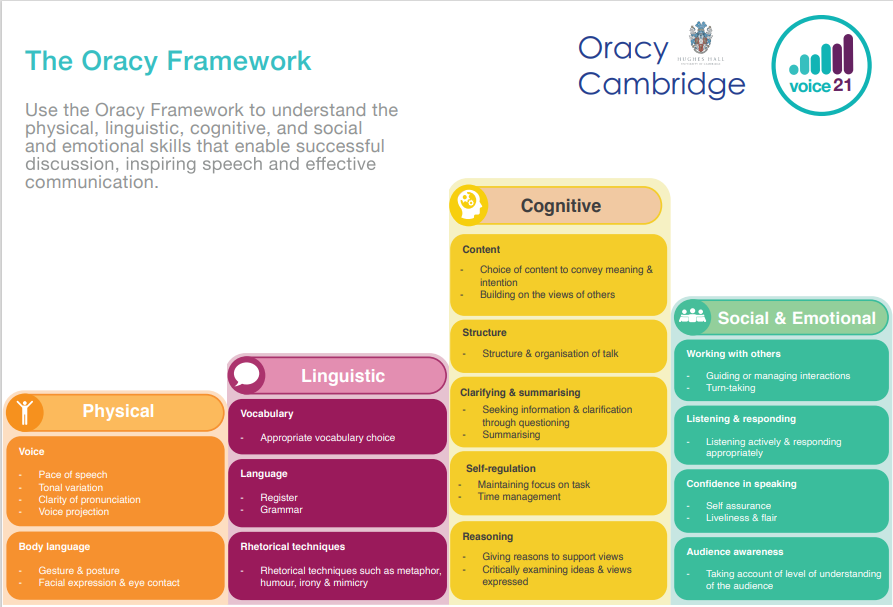
We use the Oracy Framework (Voice 21, Pictured below) to develop pupils’ oracy skills year on year. Each class has established discussion guidelines, a listening ladder and uses talk tactics to facilitate well structure and scaffolded discussion. As well as in the classroom, we offer a range of opportunities for students to use their voice for example, presenting or performing in assemblies debate club and performative poetry.

“It’s quite like a new language; it feels more mature and sophisticated.”
“It helps me use the correct words in English work (and not slang).”
“In an interview you would have to be confident, be sitting up and giving direct eye contact.”
“It helps in other subjects too - like explaining in maths.”
“I am better at explaining how I feel.”
“Speaking in front of the class is something I wouldn’t have done last year.”
"My teacher and the other children are supportive and encourage me.”
“We know we are doing it well as we are given a structure.”
“It helps with our writing.”
“My vocabulary is better and so is my pronunciation.”
Feedback from SEA visit - Spring 2025


A clause is a group of words that expresses an event or situation. It usually includes a subject and a verb A clause usually forms part of a sentence.
Example:
Tara always eats last thing at night.
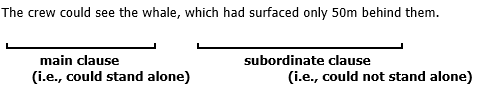
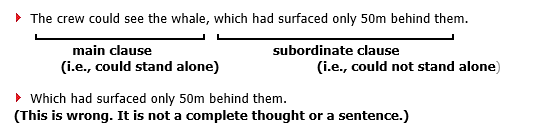
Although this is a sentence in its own right (known as a "main clause"), a clause can also represent just part of a sentence.
When a clause does not convey a complete thought, it is known as a subordinate clause.
Examples:
Trying her hardest to gain weight...
After Tara has eaten her tea...
A subordinate clause (or dependent clause) is one that cannot stand alone as a complete sentence, because it does not express a complete thought.
Examples:

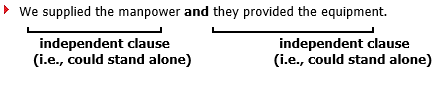
A compound sentence comprises at least two main clauses. The two clauses are joined together using a conjunction such as and, but, or, then, yet.
Example:

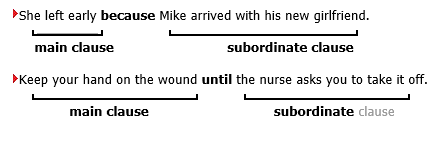
A complex sentence comprises one main clause and at least one subordinate clause.
Example:

If the subordinate clause is used to start the sentence, a comma must be used to connect it to the main clause.
A noun phrase is a group of related words which play the role of a noun. Like all phrases, a noun phrase does not have a subject and a verb.
Examples:
The shopkeeper will only allow 2 children in at once. (normal noun)
The grumpy shopkeeper will only allow 2 children... (noun phrase)
Give it back to the boy. (normal noun)
Give it back to the boy on the boat. (noun phrase)
Subordinating conjunctions are used to join subordinate clauses to main clauses. Common examples include: although, because, since, unless, until and while.
Examples:

An adverbial clause is a group of related words which play the role of an adverb. Like all clauses, an adverbial clause includes a subject and a verb.
Example:
The cleaner says she left the printer cartridge here. (normal adverb)
The cleaner says she left the printer cartridge where she always leaves it. (adverbial clause)
An adverbial phrase is a group of related words which play the role of an adverb. Like all phrases, an adverbial phrase does not include a subject and a verb. An adverbial phrase answer the questions: how, where, when or why.
Example:
Tony decided to move to Reading yesterday. (normal adverb)
Tony decided to move to Slough in June last year. (adverbial phrase)
A pronoun is a word that can be used to replace a noun.
Examples:
Marcel is tall enough, but he is not as fast as Jodie.
(The word "he" is a pronoun. It replaces "Marcel".)
Personal pronouns are the words I, you, he, she, it, we, they and who.
‘You’ is the most commonly used impersonal pronoun. Indefinite pronouns refer to people or things without saying exactly who or what they are. EG. Anybody, anyone, nobody, anything, everyone, many, others.
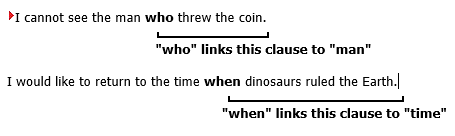
A relative pronoun is used to link one phrase or clause to another word in the sentence. The relative pronouns are: who, whom, that, which, where, when. (Whoever, whomever and whichever are also relative pronouns.)
Examples:

1st person – refers to the speaker/writer – I or we
2nd person – refers to the person/people being spoken to – you
3rd person – refers to the person/people being spoken about – he, she, they, it
Modal verbs give more information about the function of the main verb that follows it. The function shows that we believe something is certain, probable or possible.
The modal verbs are: must ought can could may might will would shall should
Examples:
He could swim when he was young. Can she really sing?
That might be a problem. Could I ask a question?
A prepositional phrase is a group of words containing a preposition and its object ( a noun or pronoun)
Preposition Object
To you
Inside his house
Under the old bridge
Examples:
Behind Mrs Grumble’s shed, lay an old, rusty spade.
Among the dark shadows, I could hear deep breathing.
An imperative sentence gives a direct command. It can end in a full stop or an exclamation mark, depending on how forceful the command is:
Examples:
Clear this desk by tomorrow!
Please tidy your room.
Writing can be classified as "emotive language" when there has been a deliberate choice of words to express strong emotion. Most ideas can be expressed in a manner that is positive or negative, welcoming or threatening, depending on the words selected.
Examples:
They were killed.
They were executed - murdered in cold blood. (emotive version)
A writer can force an entire image into the mind of a reader by simply choosing the right word with the perfect shade of meaning.
Examples: He walked along the corridor.
He glided along the corridor.
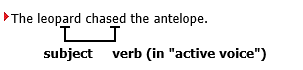
Active Voice
Verbs are said to be in "active voice" when the subject of the sentence performs the verb in the sentence.
Example:

Active Sentences
An active sentence is the opposite of a passive sentence. In an active sentence, the subject performs the action of the verb.
Tony is trimming the hedges all week.
("Tony" - active subject, i.e., doing the action (trimming))
Passive Voice
A verb is said to be in the "passive voice" when its subject does not perform the action of the verb. In fact, the action is performed on the subject.
Examples:
The bridge was blown up by engineers.
![]()
![]()
![]()
subject verb (in "passive voice")
Passive Sentences
In a passive sentence, the subject does not perform the action in the sentence. In fact, the action is performed on it.
Examples:
Anita was driven to the theatre.
(In this example, "Anita" is the subject of the sentence - subject of the verb "was". However, she did not perform the action of the verb "to drive". The action was done to her; she was the recipient of the action.)
Nowadays, kites are protected.
("kites" - passive subject, i.e., the action is being done to them)
The olives are stoned and crushed in this area.
("olives" - passive subject, i.e., the actions are being done to them)
In a passive sentence, the person or thing doing the action is often preceded by the word "by".
Determiners include many of the most frequent English words, e.g, the,a,my,this.
Determiners include:
Articles - a/an, the
Demonstratives – this/that, these/those
Possessives – my/your/his/her/its/our/their
Quantifiers – some, any, no, many, much, few ,little, both, all, either, each, every, enough
a phrase where adjacent or closely connected words begin with the same phoneme: one wet wellington; free phone; several silent, slithering snakes.
a word with a meaning opposite to another: hot - cold, light - dark, light- heavy.
A word may have more than one word as an antonym: cold - hot/
warm; big - small/tiny/little/titchy.
words which have the same meaning as another word, or very similar: wet/damp.
Avoids overuse of any word; adds variety
These are verbs that are used together with other verbs. For example:
we are going Lucy has arrived can you play
An effective text needs to be coherent and cohesive.
The term coherence refers to the underlying logic and consistency of a text.
The ideas expressed should be relevant to one another so that the reader can follow the meaning.
A word made up of two other words: football, headrest, broomstick
A conditional sentence is one in which one thing depends upon another.
Conditional sentences often contain the conjunction if:
I’ll help you if I can.
If the weather’s bad, we might not go out.
Other conjunctions used in conditionals are unless, providing, provided and as long as.
There are two ways of reporting what somebody says, direct speech and indirect speech.
In direct speech, we use the speaker’s original words demarcated with inverted commas.
Helen said, “ I’m going home.”
In indirect (or reported) speech, we report what was said but do not use the
exact words of the original speaker.
Helen said (that) she was going home.
Use of a metaphor or simile to create a particular impression or mood. A writer may develop an idea of a character’s military approach to life by using phrases and words which are linked with the army, such as: he was something of a loose cannon (metaphor); he rifled through the papers; his
arm shot out; he marched into the room; he paraded his knowledge.
words which have the same spelling as another, but different meaning: the
calf was eating/my calf was aching; the North Pole/totem pole; he is a Pole.
Pronunciation may be different: a lead pencil/the dog’s lead; furniture polish/
Polish people.
words which have the same spelling or pronunciation as another, but
different meaning or origin. May be a homograph or homophone.
words which have the same sound as another but different meaning or
different spelling: read/reed; pair/pear; right/write/rite. A homonym.
words which echo sounds associated with their meaning: clang, hiss, crash,
cuckoo.
use of language to create a vivid sensory image - often visual. May include:
Vocabulary choice of synonym, for example sprinted/ran/raced, selection
of adjectives and adverbs
simile he ran like the wind
metaphor his feet had wings
a form of metaphor in which language relating to human action, motivation
and emotion is used to refer to non human agents or objects or abstract
concepts: the weather is smiling on us today; Love is blind.

Last week, we held our 2025 Spelling Bee. There were 5 finalists from each class, competing against other spellers in their year group. The final was very exciting and tense but everyone enjoyed it. Well done to the winners!
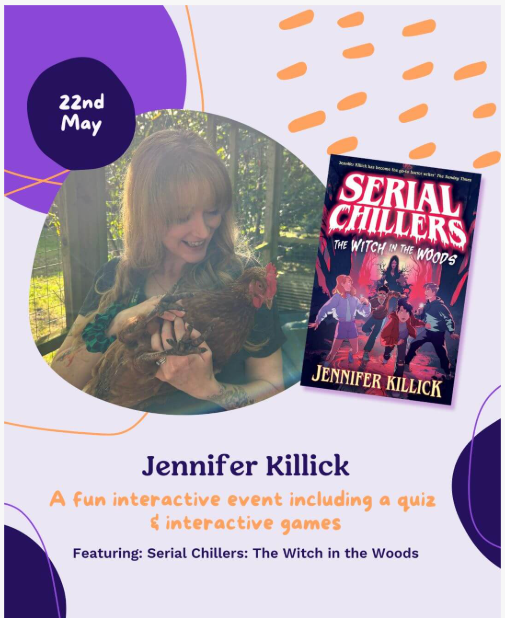
6C have enjoyed reading books written by this author so we were very excited to join this event to find out a bit more about the author and her new series of books:
Kornelija- it was a fun experience. She made her own version of Rock, Paper, Scissors and we got to play against her. We also got to ask questions. If you like reading Jenifer Killick books, you'll love her new series. She's writing about Blood eyed Mary.
Dylan -on 22nd May, 6C took part in a zoom call (with lots of other schools) with a famous author, Jennifer Killick. I really liked the call because she showed us all of the books she'd written. I didn't know that she used to write comedy books. She told us that she is releasing a new series called 'Serial Chillers'. It's about some teenagers that live in a place called Hazard. They are assigned a project but things take a turn for the worse. I'm very interested in reading and really enjoyed it. Thank you, Mrs Cleaves.

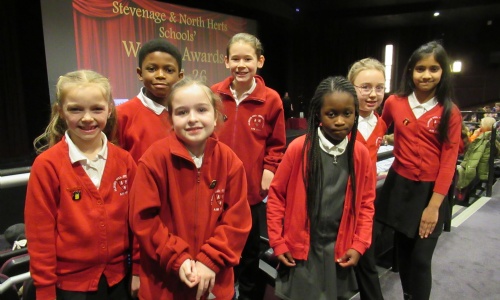
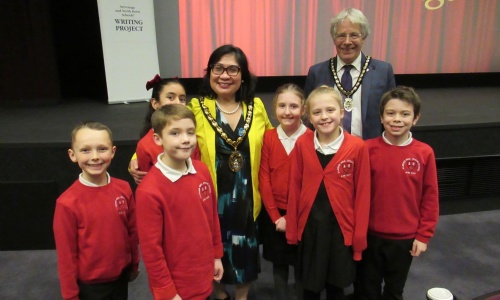
Mrs Cleaves, Miss Simmons and Mrs Fordham, were delighted to attend the North Herts and Stevenage Schools’ Writing Awards ceremony ast night where the cream of the crop (5000 participants) represented the Almond Hill community. With two children collecting ‘progress’ awards and two collecting ‘endeavour’ awards (one of each for lower and upper school), the evening started well! Following this were Best Writer awards for each year group where four children were nominated from Almond Hill and they proudly collected their certificates and medals. Next week, Mrs Cleaves will be awarding certificates for progress, endeavour and best writer for each class in out weekly Friday celebration assembly. Thank you to staff, parents and the children for attending this wonderful event.
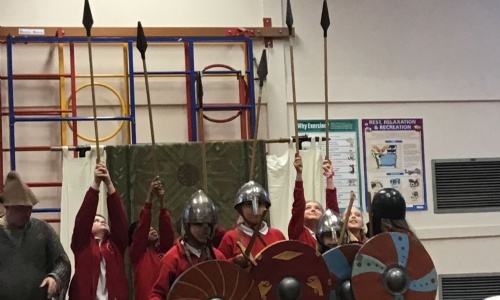
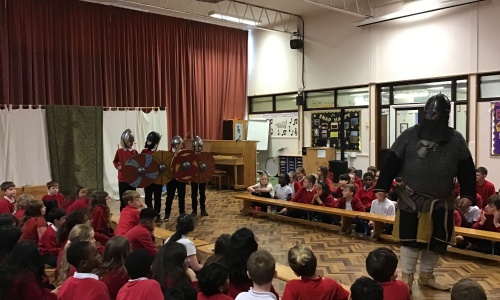
Year 5 had a visitor from Time Capsule Education on Monday. They were told the story of Beowulf and Gredel in all its gruesome detail and then looked at Viking and Saxon Weapons and warfare. They were able to look at spears, helmets and swords as well as mail tunics. They also learnt about how the Vikings and Saxons hurt people. During the afternoon, the children learnt about the Battle of Maldon and then some children took part in a reenactment of a battle. They loved it!
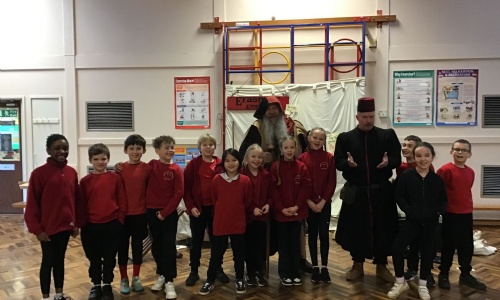
Year 4 were very lucky to spend a whole day with Tim and John working on their 'Castle Courageous' unit of writing. They learnt all about the genre of fantasy writing and the idea of portals in stories. They were introduced to the world in which Castle Courageous stands. They visited a magical emporium and investigated all the different things that could be bought there. After this, Year 4 considered which characters they might want as companions, which places they might meet them and how they might be useful on their journey. Everyone loved looking at all the models of the settings and characters in the afternoon. They inspired a lot of talk about what might be happening, ideas of how to describe the settings accurately and ignited our imaginations ready to get writing!
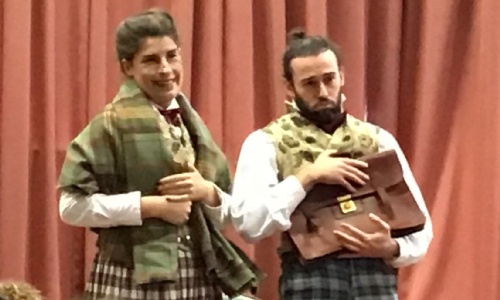
On Monday, Year 6 were lucky enough to watch a dramatised reading of A Christmas Carol. It was a wonderful production and is sure to help inspire the children in their writing. The children loved it too...
Nathan 6C : The play was a great experience for us because the acting was amazing and it was a huge help with our writing.
Sophie 6C: The Christmas Carol was an excellent show!. An old man named Scrooge hated Christmas but when 3 spirits haunted him, I was relieved it was just a dream. Lovely show!
Dylan 6C: 3 people came in and performed the classic play, 'A Christmas Carol'. I really enjoyed the part when Scrooge wakes up and is happy that he didn't die.
Year 3 and 4 were incredibly lucky to meet with real author Colm Field on Wednesday. He told us all about how he writes his books (on his phone!) and what inspires him to write his stories. We even got to start writing our own story in another dimension that included a large set of teeth!
"I enjoyed hearing about being an author. It could help us write a book in the Future." Benjamin
"I really enjoyed the afternoon and it has inspired me to start writing." Ava M
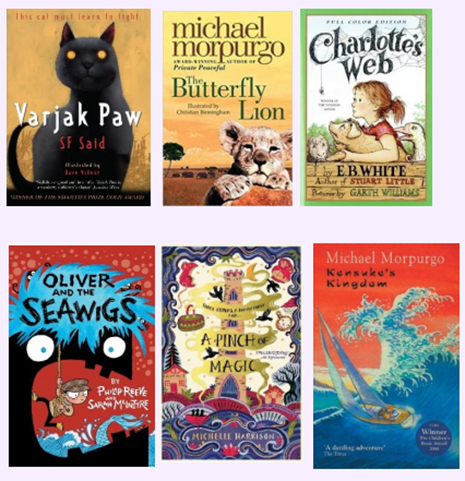
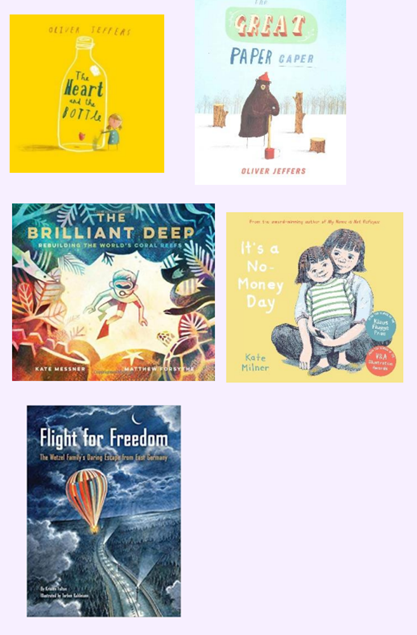
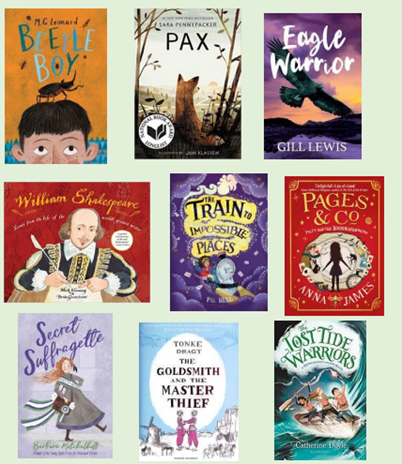
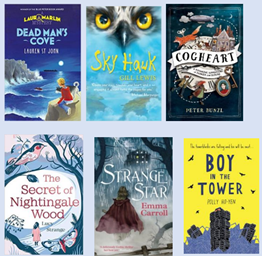
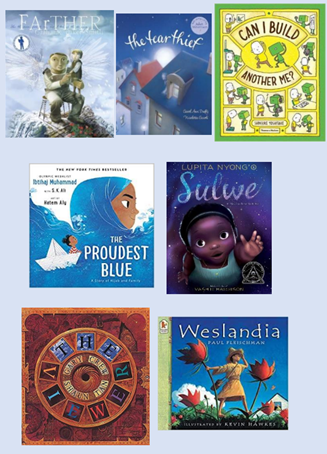
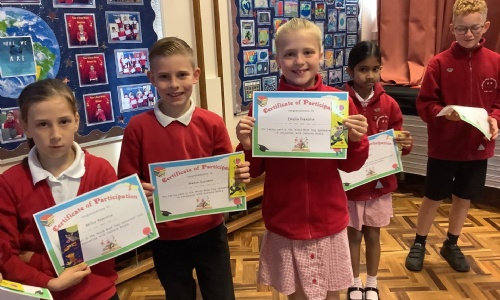
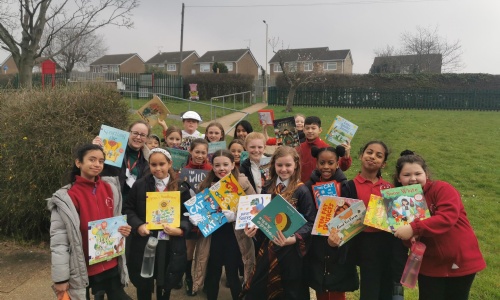
I am sure children have been telling you all about the wonderful new books that have landed in our class libraries over the last couple of weeks. Our Year 6 HTAs have been working very hard getting these labelled and distributed. We have still have some books left to arrive which will be delivered after half term. This week in assembly, children were presented with their certificates of participation and our winners were announced…
Lower School Winner – Idris in Year 3
Upper School Winner –Ahyan in Year 5
Both winners selected a book of their choice as a prize. Happy reading!
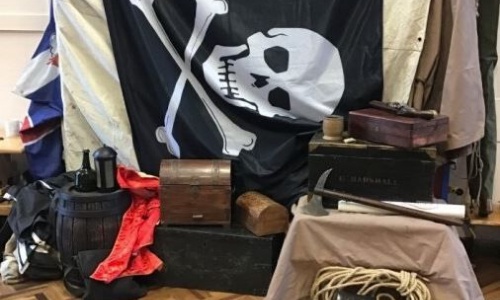
Lots of us dressed up for the occasion as we learnt all about real pirates and story book pirates. We asked lots of questions so we could learn all about the jobs, food, weapons and what pirates wore. We made our own treasure maps, wrote a pirate code for our own pirate ship and designed our own pirate flags. We also got to play a game of 'Pursuit' - a pirate ship chase game! We had a fabulous time and are very excited to start writing our own non-fiction text all about pirates.
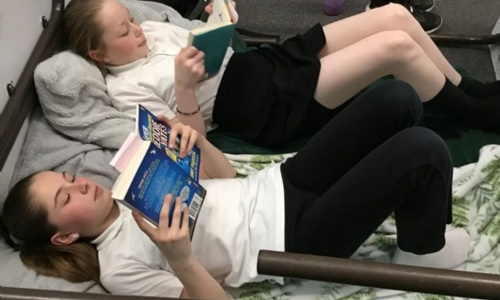
6C had a cosy reading morning to celebrate reading over 100 books this year! Well done!
Some selected children from Year 6 were invited to go to Letchmore to read with younger children. This was a reward/positive consequence for their contribution to the school e.g Reading Mentors and Headteacher Assistants.
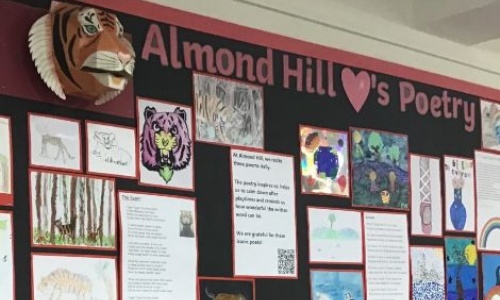
Mrs Lyons has coordinated another wonderful display in Stevenage Library showcasing some of the fantastic poetry that has been written in class. Please go and visit this with your children and hopefully borrow some books at the same time.
We have just completed the North Herts and Stevenage Schools writing project based on the picture book, 'Here We Are' by Oliver Jeffers. The children wrote some fantastic poems and also produced some excellent art projects. On Thursday 8th Feb, pupils from all year groups proudly represented Almond Hill at the awards evening held at the Broadway Theatre in Letchworth. Congratulations to everyone but a huge well done to Danny in year 5 who won runner up for best writer and Aahana in year 6 who won best writer.
Year 5 had a wonderful 'inspire writing' day on Monday. Our two visitors re-enacted the story of Beowulf and Grendel (our year 5 class reader and English book), then discussed typical weapons that would have been used in the Anglo-Saxon and Viking times and then re-enacted (with some excellent volunteers) a famous battle before ending the day with a Q&A session. The children listened incredibly well and had some brilliant questions at the end. We will definitely use all our new knowledge to help our writing and history lessons.
On Tuesday, Year 4 had a visit from Time Capsule Education. The children were introduced to their own fantasy adventure - a journey through a portal to Castle Courageous! We visited the local emporium to properly equip ourselves for an adventure, designed a companion to accompany our quest and planned our fantasy worlds where our stories will be set. We are looking forward to using these ideas next to inspire our writing.
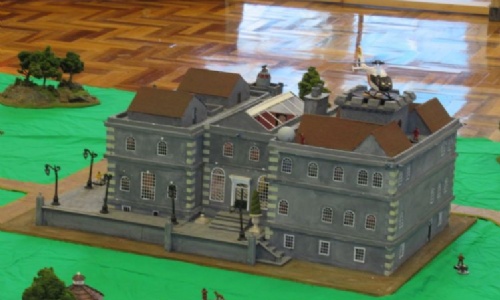
Last week, Tim and Jon from Time Capsule Education spent an exciting day with our year 6 pupils training them to be spies! They cracked a secret code, carried out some undercover surveillance, investigated a miniature stately home and even cracked open a safe! The children enjoyed all of the activities and can't wait to start writing their own spy stories!
Poetry by Heart is a national poetry speaking competition for schools in England. It is open to young people in Key Stages 2-5. Pupils choose a poem, learn it by heart, and perform it. 3 classes at Almond Hill took part in the competition and received certificates for their entries.
To achieve this in a national competition is something you can be very proud of. To help take your poetry performance further, the judges have offered this advice, just for you:
5C - Endandgered (John Mole) - Highly Commended
Well done for learning this poem so well and contributing to a strong performance. We loved the actions, but make sure the words are not lost - you can afford to slow down a little, and vary the emphasis in the lines.
3A - From A Railway Carriage (Robert Louis Stevenson) - Commended
It is lovely to see that you all made such an effort to learn this poem together, and perform it so confidently. You worked well to express the poem's rhythm but see if you can vary this a little bit in places.
6S - Invictus (W.E Henley) - Commended
We found this moving, especially the way your performance emphasises the power of the final line. This would be even more effective if you could vary the pace and emphasis within lines.
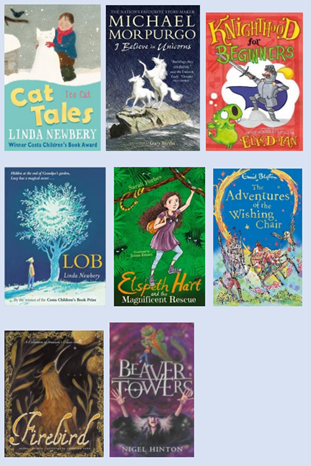
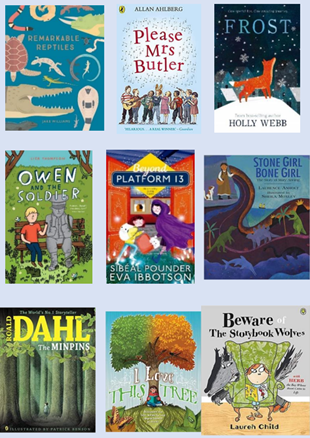
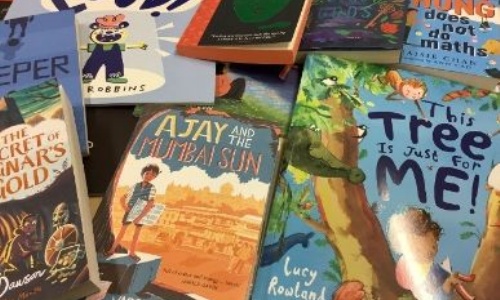
I am very grateful to the parents and children who are engaging in our monthly preloved book sale. I am incredibly pleased to tell you that these book sales (which were first brought in by a previous school government) funded the purchase of new books for the classes which were given out in assembly this week. We are dedicated to sustaining and improving our class libraries. I purchased the books from David's bookshop in Letchworth who give us 20% discount and delivery free of charge! It is a really lovely bookshop where I selected some books this month for those more reluctant readers, diverse novels encouraging wider representation and picture books with a moral or personal development message. I hope the children will enjoy reading them. We have a book sale once a month.
On Thursday 6th October, we held a 'Reading and Phonics Workshop' where we outlined our aims and expectations for reading and phonics at Almond Hill. During the workshop, we shared the ways in which we teach reading and comprehension, the additional provision that we provide to further develop the children and the information and resources that are available to support at home.